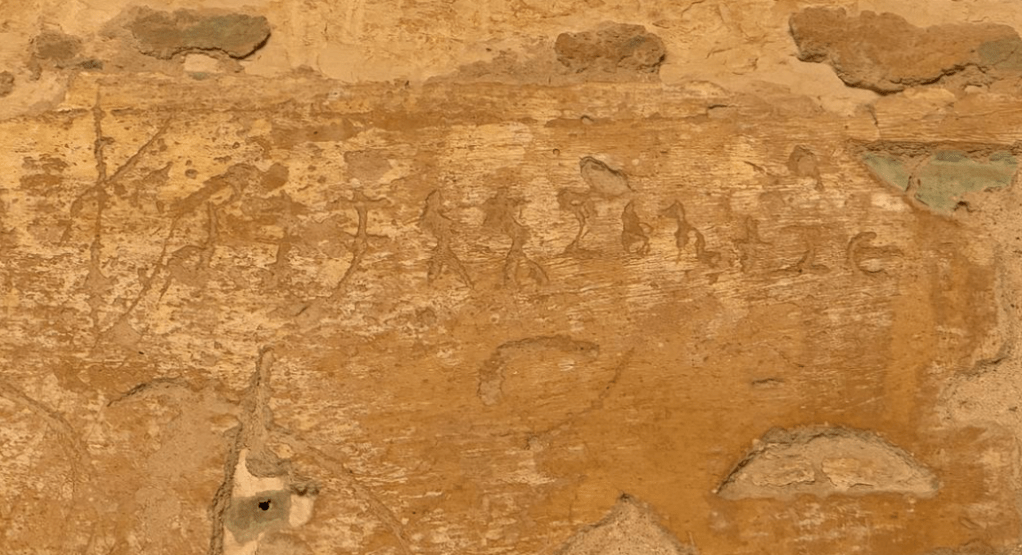
Recent research has unveiled groundbreaking evidence of ancient connections between India—specifically Tamilagam—and the Roman Empire. In a 2024–2025 study, researchers Charlotte Schmid (EFEO) and Ingo Strauch (University of Lausanne) documented nearly 30 inscriptions across six tombs in Egypt’s Theban Necropolis. Dating from the 1st to the 3rd centuries C.E., these texts are written in Tamil-Brahmi, Sanskrit, and Prakrit.
Crucially, this discovery proves that South Asian merchants did not simply drop anchor at Red Sea ports and return home. Instead, they traveled deep inland to Thebes, leaving their marks alongside Greek and Latin travelers.
Key Discoveries and Linguistic Hybridity
The inscriptions provide fascinating glimpses into the identities of these ancient travelers:
- Cikai Koṟṟaṉ: This name appears eight times across five tombs, sometimes placed high up near entrances to ensure visibility. The name itself is a cultural hybrid: “Cikai” likely stems from the Sanskrit śikhā (tuft or crown), while “Koṟṟaṉ” has deep Tamil roots tied to victory and royalty (echoing the Chera goddess Koṟṟavai).
- Kopāṉ varata kantan: Translating to “Kopāṉ came and saw,” this inscription features a name with direct historical parallels in Tamil Nadu.
- Other Familiar Names: The names Cātaṉ and Kiraṉ, frequently found in early South Indian Tamil-Brahmi records, were also identified.
These linguistic blends highlight the cosmopolitan nature of early Indian merchant communities, suggesting that multilingualism was a common, practical trait rather than an exception.
The Significance of Inland Travel
These findings indicate that Indian traders were wealthy and leisurely enough to sightsee, travel inland, and participate in local commemorative traditions. Schmid notes they were highly literate in their own scripts and likely conversant in Greek.
While classical Latin texts such as Periplus of Erythrian Sea and Pliny’s Natural Histroica have long documented the flow of Indian pepper, ivory, and textiles to the West, there has been ongoing debate about whether this trade was merely one-sided. These inscriptions provide concrete evidence of a robust, bidirectional exchange of both goods and people. However, historians note that while this discovery enriches the human element of this history, the traditional framework of Indo-Roman trade remains largely unchanged.
The Traditional Trade Framework
The established understanding of this commerce is heavily based on the Periplus of the Erythraean Sea, which details the bustling imports and exports at Indian ports like Barygaza (modern-day Bharuch).
- Imports to India: Italian and Arabian wines, copper, tin, lead, coral, glass, precious metals, and foreign coins (which yielded a profitable exchange rate). The royal courts also imported luxury items like fine silver vessels, high-quality clothing, singing boys, and maidens.
- Exports from India: Ivory, silk, cotton cloth, long pepper, spikenard, and precious stones like agate and carnelian.
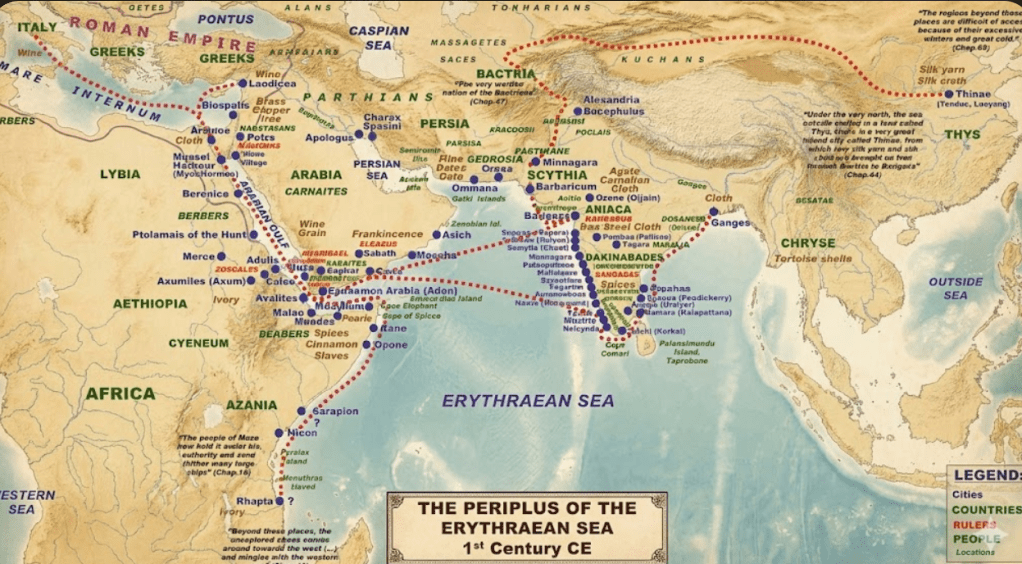
The Periplus also notes that the inland city of Ozene (Ujjain) was a vital hub, supplying Barygaza with textiles and gemstones for export.
Physical evidence of this vast trade network can be seen in artifacts like the “Pompeii Lakshmi,” an Indian statuette discovered in the ruins of Pompeii. Historians suggest it may have originated near the Bhokardan area during the reign of the Western Satrap Nahapana before being shipped to Rome via Barygaza.
Conclusion
The discovery of Tamil-Brahmi, Sanskrit, and Prakrit inscriptions in the Theban Necropolis adds a vibrant, human dimension to the well-documented Indo-Roman trade network. While foundational texts like the Periplus of the Erythraean Sea and artifacts like the Pompeii Lakshmi have long proven the vast exchange of goods across the ancient world, these inscriptions prove the deep exchange of people. They reveal that ancient Indian merchants were not just coastal traders, but cosmopolitan explorers who navigated diverse linguistic landscapes, traveled far inland into Egypt, and quite literally carved their names into global history.
Ultimately, these findings do not rewrite the economic history of the era, but they profoundly enrich our understanding of the bold, literate, and worldly individuals who drove it.
 Sainil Nagare
Leave a comment