For decades, historians relied primarily on literary sources to reconstruct the history of early South India. The famous poems of Sangam Literature (300BCE to 200 CE) described a vibrant society of warriors, poets, traders, and kings. However, critics often argued that these literary works might contain exaggerations or poetic imagination rather than historical reality.
However, the archaeological discoveries at Keezhadi, located near the Vaigai River in Tamil Nadu, have begun to transform this debate. Excavations at this site have produced remarkable material evidence of an advanced and organized society, pushing historians to reconsider many long-held assumptions about the Sangam Age.
Today, Keezhadi is widely regarded as one of the most important archaeological discoveries in South Asian history, because it provides concrete proof of the social, economic, and cultural life described in Sangam texts.
The Discovery of Keezhadi
The site of Keezhadi lies along the fertile basin of the Vaigai River, an area historically associated with early Tamil settlements. Excavations began in 2015 under the supervision of the Archaeological Survey of India and later continued under the Tamil Nadu State Department of Archaeology.
What archaeologists discovered beneath the soil was astonishing. They uncovered the remains of an ancient urban settlement with well-planned structures, industrial areas, and thousands of artifacts. Over successive excavation seasons, the site has yielded pottery, tools, ornaments, inscriptions, and architectural remains, offering a detailed glimpse into the daily life of ancient Tamil society with dates around 6th century BCE.
These discoveries have forced historians to rethink the scale and sophistication of the civilization associated with the Sangam Age.
1. Evidence of Urban Planning
One of the most striking findings at Keezhadi is the evidence of organized urban planning. Archaeologists have unearthed brick buildings, drainage systems, ring wells, and streets, indicating that the settlement was carefully designed rather than randomly constructed.
The presence of drainage channels and water management systems suggests that the inhabitants had a strong understanding of sanitation and urban infrastructure. Such features are typically associated with developed urban societies rather than rural settlements.
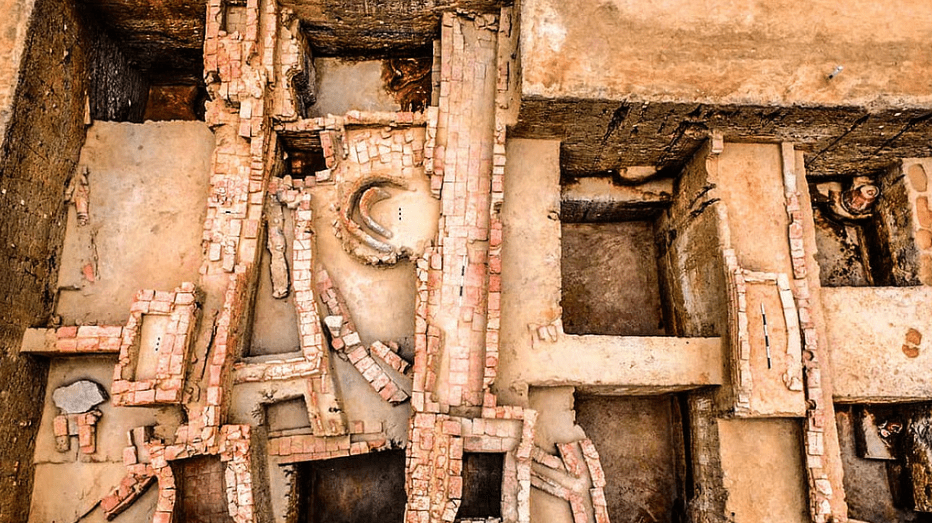
Earlier, historians believed that after the decline of the Indus Valley Civilization, large urban centers were mainly concentrated in the Gangetic plains of northern India. Keezhadi challenges this assumption by demonstrating that urbanization also flourished in the Tamil region during the early historic period.
This discovery highlights the possibility that multiple centers of urban development existed in ancient India, rather than a single dominant region.
2. Proof of Early Literacy
Another remarkable discovery from Keezhadi is the presence of Tamil-Brahmi inscriptions on pottery and other artifacts.
These inscriptions contain names, symbols, and short texts, suggesting that writing was used in everyday life. The presence of such inscriptions on common objects indicates that literacy may have been more widespread than previously assumed.
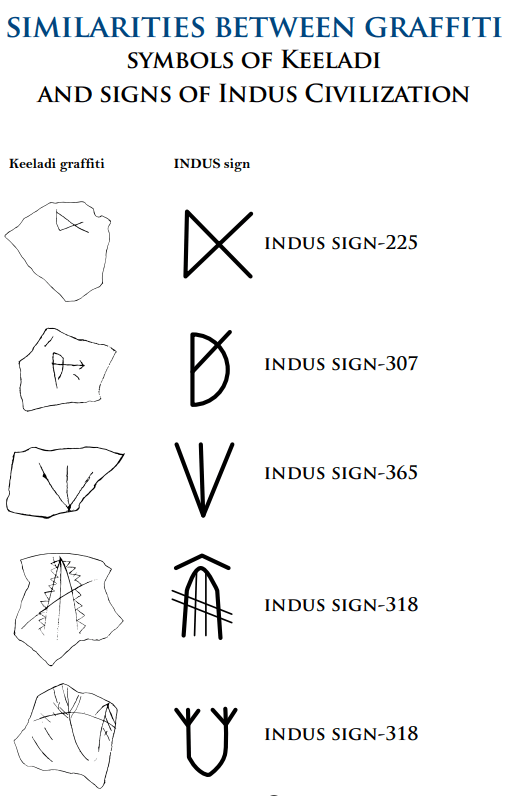
This finding is particularly significant because it supports the historical authenticity of Sangam literature. The poems in these texts refer to a society that valued poetry, learning, and intellectual expression, and the inscriptions found at Keezhadi suggest that writing was indeed an integral part of that culture.
For historians, this discovery provides material confirmation that the literary traditions of ancient Tamil society were rooted in a real historical context.
3. A Thriving Craft Economy
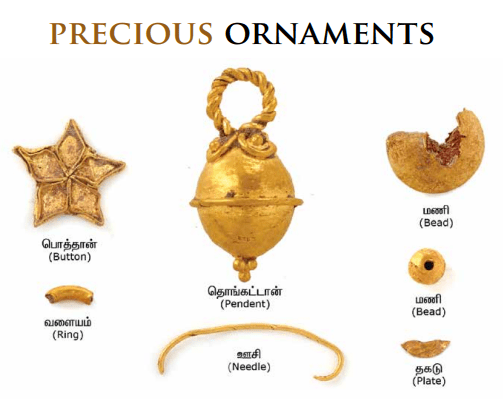
The excavations have also revealed extensive evidence of industrial and craft activities. Archaeologists discovered bead-making workshops, pottery kilns, iron tools, and ornaments made from semi-precious stones. These findings indicate that Keezhadi was not just a residential settlement but also an important center of craft production.
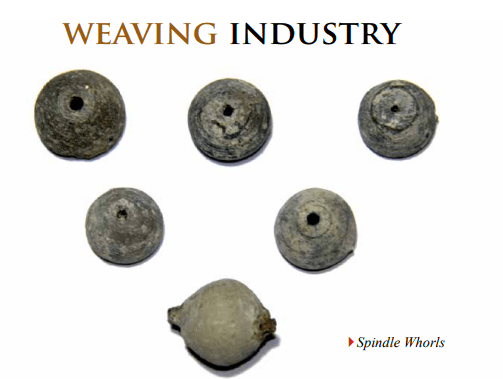
The presence of specialized crafts suggests the existence of professional artisans and organized economic activity. Such specialization is usually associated with complex social structures, where different groups perform distinct economic roles.
These discoveries align closely with descriptions found in Sangam literature, which refers to merchants, artisans, and traders as important members of society.
(Source – ibid)
How these dicoveries are impacting the traditional understanding of Indian History?
For many years, historical writing in India focused heavily on developments in the northern subcontinent, particularly the Gangetic plains and the empires that emerged there. South Indian history was often treated as a later or secondary development.
Traditional historiography consider prehistorical time period (i.e. stone ages) in India was followed by Proto Historical Time Period i.e. Harappan Civilisation (3300BC to 1300BC) in north India. Since Harappan civilisation was urban in nature, collapse of long distance trade (i.e. with Mesopotamia) consequently led to decline of Harappans from 1800 BCE onwards.
Traditional historiography then shifts its focus upon Aryan Civilisation i.e. Vedic Civilisation which started from 1500 BCE to 600 BCE which evolved itself into Mahajanapads from 600 BCE onwards. Within Mahajanpada there was a rise of Magadh Mahajanpada which was ruled by dynasties like Hayanaka, Shishunaga, Nandas and Mauryas. It was this Magadh Mahajanapada that united India by the time period of Ashoka (269 BCE -232 BCE). Ashoka mentions Cholas, Cheras, Pandyas and Satyaputras are his friendly neighbours in his Major Rock Inscription no. XIII.
According to this timeline Prehistoric time period was followed by development of 2 phases of urbanisation only in North India. One was Harappan which is called as era of first urbanisation in India and then Mahajanapada which is called as era of 2nd urbanisation in India. Sadly both phases were being confined only in north India.
South India during this time was dominated by Megalithic period (1000 BCE to 100 CE) as per traditional historiography. Even Sangam age is placed to around 300 BCE to 200 CE.
Thus, the discoveries at Keezhadi archaeological sites have revolutionized the study of the Sangam Age. By providing archaeological evidence of urban planning, literacy, craft specialization, and trade networks, the site confirms many aspects of early Tamil society described in Sangam literature that is now being shifted to 600 BCE thanks to Keezhadi excavations.
Hence this discovery by placing Sangam time period to 600 BCE challenges the traditional version. Further by linking to Harappans via similarities of script Tamil scholars are of opinion that with arrival of Aryans in north Hrappans migrated to deep south. In other words Harappan civilisation belonged to Tamils.
And that is the catch. Challanging the traditional version means accepting Tamilians are true inhabitants of India and Arans arrived from outside thereby casting doubts on genesis of Hindu religion itself.
Nonethless, as research continues, Keezhadi is likely to remain at the center of debates about the origins and evolution of early Tamil culture, making it one of the most significant archaeological sites in modern India.
 Sainil Nagare
Leave a comment