Mahatma Jyotirao Govindrao Phule (11 April 1827 – 28 November 1890) stands as one of the most pioneering social revolutionaries of modern India, whose life was dedicated to dismantling structures of caste oppression and social inequality. Born in Katgun village in present-day Satara district and later raised in Pune, Phule belonged to the Mali caste, traditionally associated with horticulture and considered part of the Shudra varna. His early life was marked by both deprivation and resilience. His mother died when he was young, and the responsibility of assisting in the family’s modest flower and vegetable business fell upon him early.
Despite these constraints, Phule was enrolled in a Scottish Mission School in Pune around 1841, an opportunity that exposed him to Western liberal thought, particularly the ideas of equality, rationalism, and human rights. He was influenced by thinkers such as Thomas Paine, whose work The Rights of Man shaped his critique of hierarchy and privilege. However, his education was neither continuous nor socially accepted; orthodox sections of society opposed the education of lower-caste individuals, and he faced constant discouragement.
The defining moment of his youth came when he was insulted and expelled from a Brahmin wedding procession upon the discovery of his caste identity, an incident that profoundly transformed his consciousness and set him on a lifelong path of resistance. Phule’s early struggles were not merely personal but structural, reflecting the deeply entrenched inequalities of nineteenth-century Indian society. As a young man, he encountered both economic limitations and rigid social barriers that sought to confine him within the traditional occupation of his caste. His pursuit of education itself was seen as transgressive, and his reformist activities soon led to severe backlash from society.
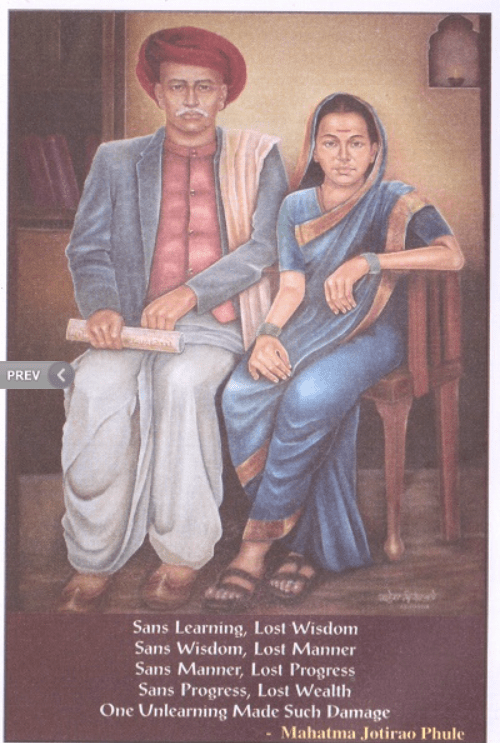
When he and his wife Savitribai began educating girls and lower-caste children, they were subjected to intense social ostracism. Phule was expelled from his own family home by his father under pressure from orthodox elements, forcing the couple to rely on the support of progressive individuals such as Usman Sheikh and his sister Fatima Sheikh, who provided them shelter and space to run their school. Savitribai herself faced daily harassment, including being pelted with mud and stones on her way to teach, yet Phule remained steadfast, demonstrating extraordinary courage and conviction in the face of adversity.
Recognizing education as the most powerful tool for social transformation, Phule initiated a revolutionary movement in the field of mass education. In 1848, at the age of twenty-one, he established the first school for girls in Pune at Bhide Wada, with Savitribai Phule as its first teacher. This was followed by the establishment of several more schools for girls, Shudras, and Ati-Shudras, including Dalits, at a time when education was monopolized by upper castes and denied to the majority. By 1851–52, the Phules were managing nearly 18 schools, an unprecedented effort in indigenous education. Their work was acknowledged by the colonial government, which commended their contribution to education, yet socially they remained isolated and targeted by conservative forces.
Among the earliest documented beneficiaries of this movement was Muktabai, a young girl from the Mang community, who studied in Phule’s school and later wrote a remarkable essay titled “Mang Maharanchya Dukhavisayi” (On the Sufferings of the Mangs and Mahars) in 1855. In this piece, she powerfully articulated the lived realities of caste oppression, making it one of the earliest known writings by a Dalit girl in India. Her voice stands as a testimony to the intellectual awakening that Phule’s educational efforts made possible. Another important figure associated with this movement was Fatima Sheikh, who, although a collaborator and teacher rather than a student, represents the inclusive nature of Phule’s educational mission, as a Muslim woman actively participated in and contributed to this transformative project.
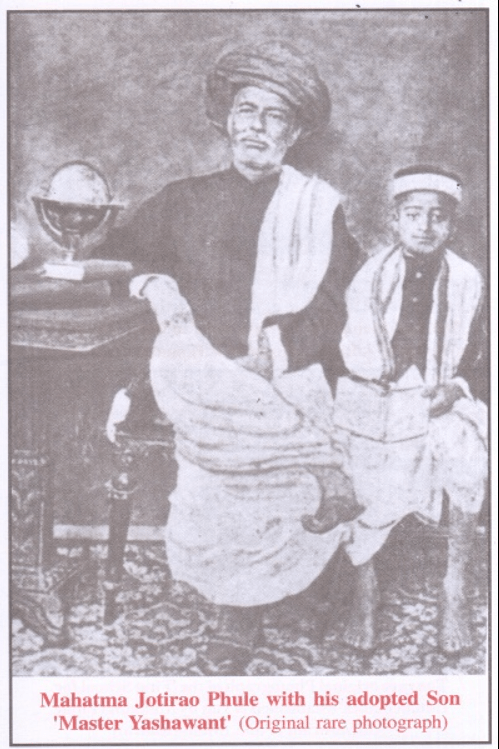
Phule’s reformist vision extended deeply into the domain of social justice, particularly concerning the condition of women. He was among the earliest reformers to address the plight of widows, who were often victims of social stigma and driven to infanticide. In 1854, he established the Balhatya Pratibandhak Griha, a shelter for pregnant widows and abandoned children. In a radical departure from social norms, he and Savitribai adopted a child born to a Brahmin widow, symbolically rejecting caste prejudice and affirming the dignity of all human life. He also actively opposed child marriage and supported widow remarriage, integrating gender justice into his broader critique of social inequality.
At the heart of Phule’s ideology was a powerful critique of Brahmanical hegemony and the caste system. He argued that caste hierarchy was historically constructed to maintain the dominance of a minority over the majority, whom he termed the “Bahujan.” To institutionalize his ideas, he founded the Satyashodhak Samaj in 1873, an organization dedicated to the liberation of Shudras and Ati-Shudras from religious and social exploitation. The Samaj rejected the authority of Brahmin priests, promoted rational thinking, and conducted social ceremonies such as marriages without Brahmin rituals. It sought to create a parallel social structure based on equality, self-respect, and direct access to spiritual and social practices.
Phule’s literary contributions played a crucial role in articulating and disseminating his ideas. His seminal work Gulamgiri (1873) offered a scathing critique of caste oppression, drawing parallels with racial slavery in America and challenging the ideological foundations of Brahmanical supremacy. In Shetkaryacha Asud (1881), he exposed the exploitation of peasants under colonial policies and indigenous elites, highlighting issues such as heavy taxation, indebtedness, and neglect of rural welfare. His work Sarvajanik Satya Dharma Pustak proposed a universal religion grounded in truth, morality, and equality, rejecting ritualism and hierarchy. Through these writings, Phule not only critiqued existing systems but also envisioned an alternative social order rooted in justice and rationality.
Phule’s contributions must be situated within the broader landscape of nineteenth-century reform movements, yet his approach was distinctly radical and inclusive. Unlike many contemporary reformers who focused on upper-caste concerns, Phule centered his efforts on the most marginalized sections of society—lower castes, women, and peasants. His ideas laid the intellectual foundation for later anti-caste movements and profoundly influenced leaders such as Shahu Maharaj and Dr. B. R. Ambedkar, who would carry forward the struggle for equality and social justice in the twentieth century. In recognition of his immense contributions, Jyotirao Phule was conferred the title “Mahatma” by his followers during his lifetime. Despite enduring relentless opposition, he remained unwavering in his commitment to social reform until his death on 28 November 1890. His life was a testament to the power of education, critical thought, and moral courage in challenging injustice.
On his birth anniversary, remembering Mahatma Phule is not merely an act of tribute but a reaffirmation of the values he embodied. His life story—marked by struggle, resistance, and transformative vision—continues to inspire generations. The story of students like Muktabai reminds us that Phule’s revolution was not abstract but deeply human, enabling the oppressed to find their voice and assert their dignity. In a society still grappling with issues of caste discrimination, gender inequality, and unequal access to education, Phule’s ideas remain profoundly relevant. His legacy serves as a reminder that true progress lies in the upliftment of the most marginalized, and that the pursuit of equality and justice is an enduring and collective responsibility.
 Sainil Nagare
Leave a comment